Recommended AI Tools
5We've analyzed the market. These tools offer specific features for clone your own voice.
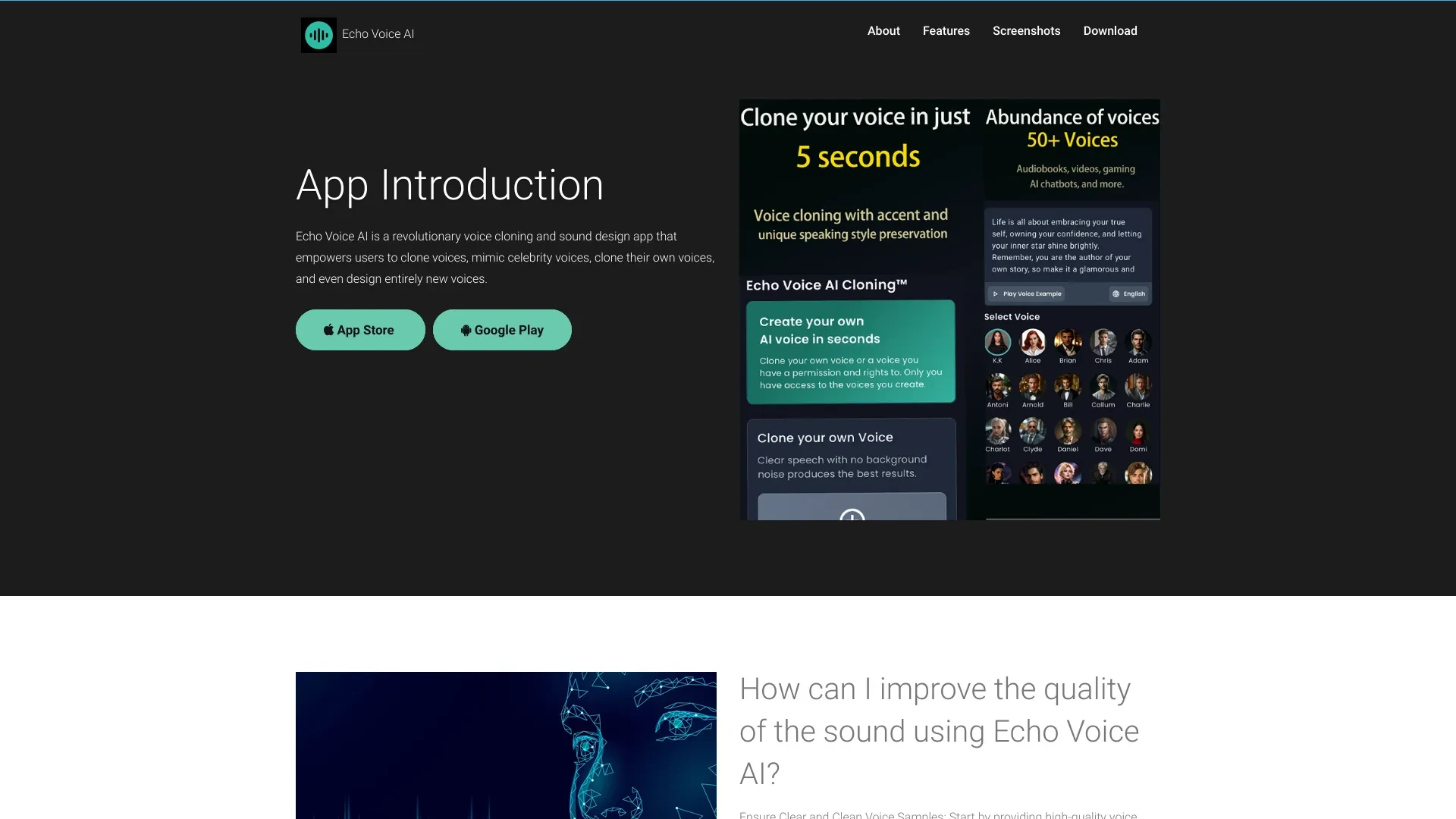
Echo Voice AI
Echo Voice AI is an innovative app that allows users to effortlessly clone and design voices with cutting-edge sound technology.
- Voice Cloning
- Mimic Celebrity Voices
- Clone Your Own Voice
AI Analysis
Why use this AI Echo Voice AI for Clone Your Own Voice?
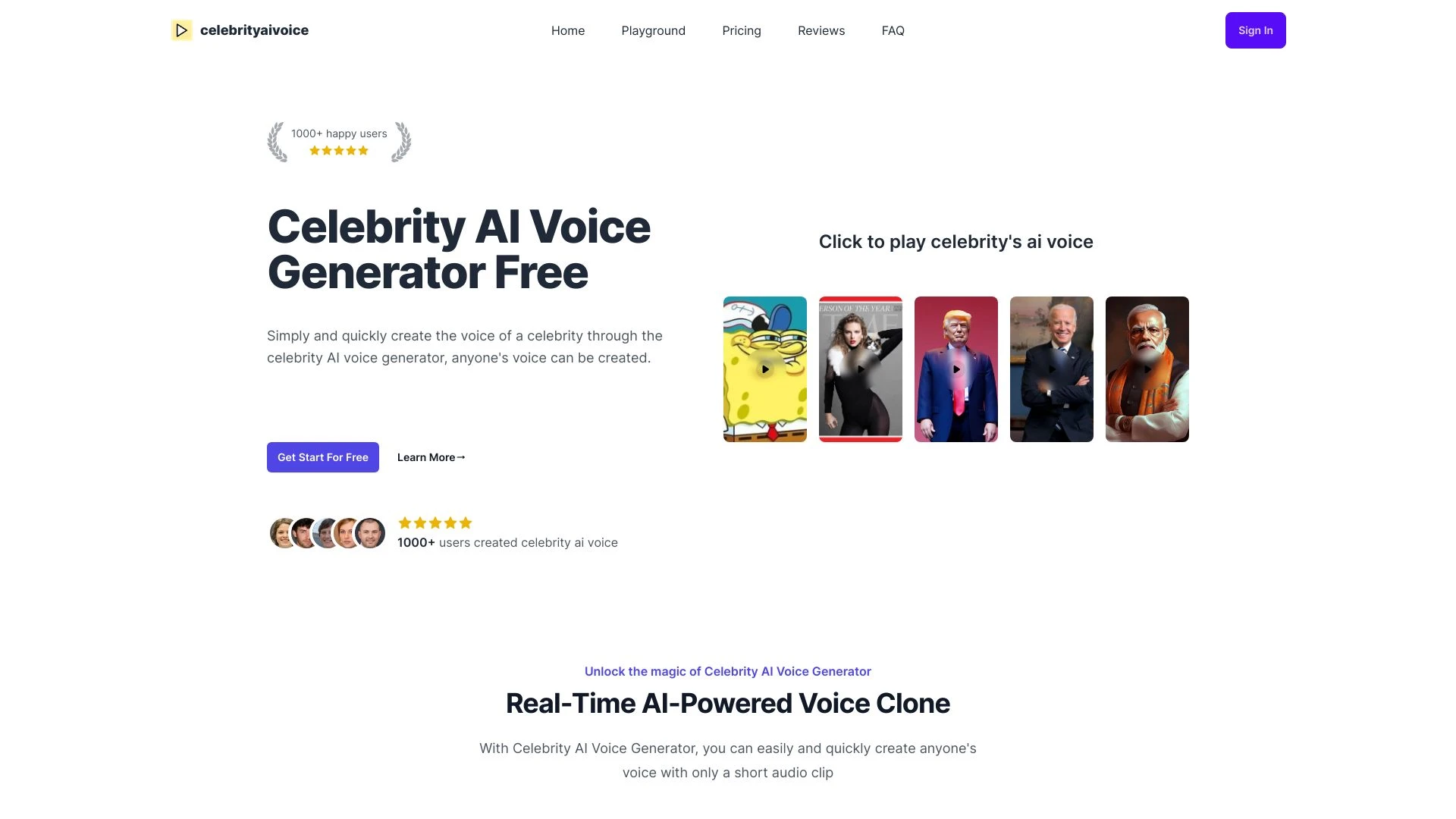
Effortlessly create lifelike AI voices of celebrities with this intuitive voice generator.
- Real-Time AI-Powered Voice Clone
- Instant Voice Cloning
- Granular Control Over Voice Styles
AI Analysis
Why use this AI Celebrity AI Voice Generator for Clone Your Own Voice?

MyVocal.ai
MyVocal.ai offers an innovative way to clone your voice for both singing and speaking through quick and user-friendly tools.
- Voice Clone
- Text to Speech
- Text to Song
AI Analysis
Why use this AI MyVocal.ai for Clone Your Own Voice?
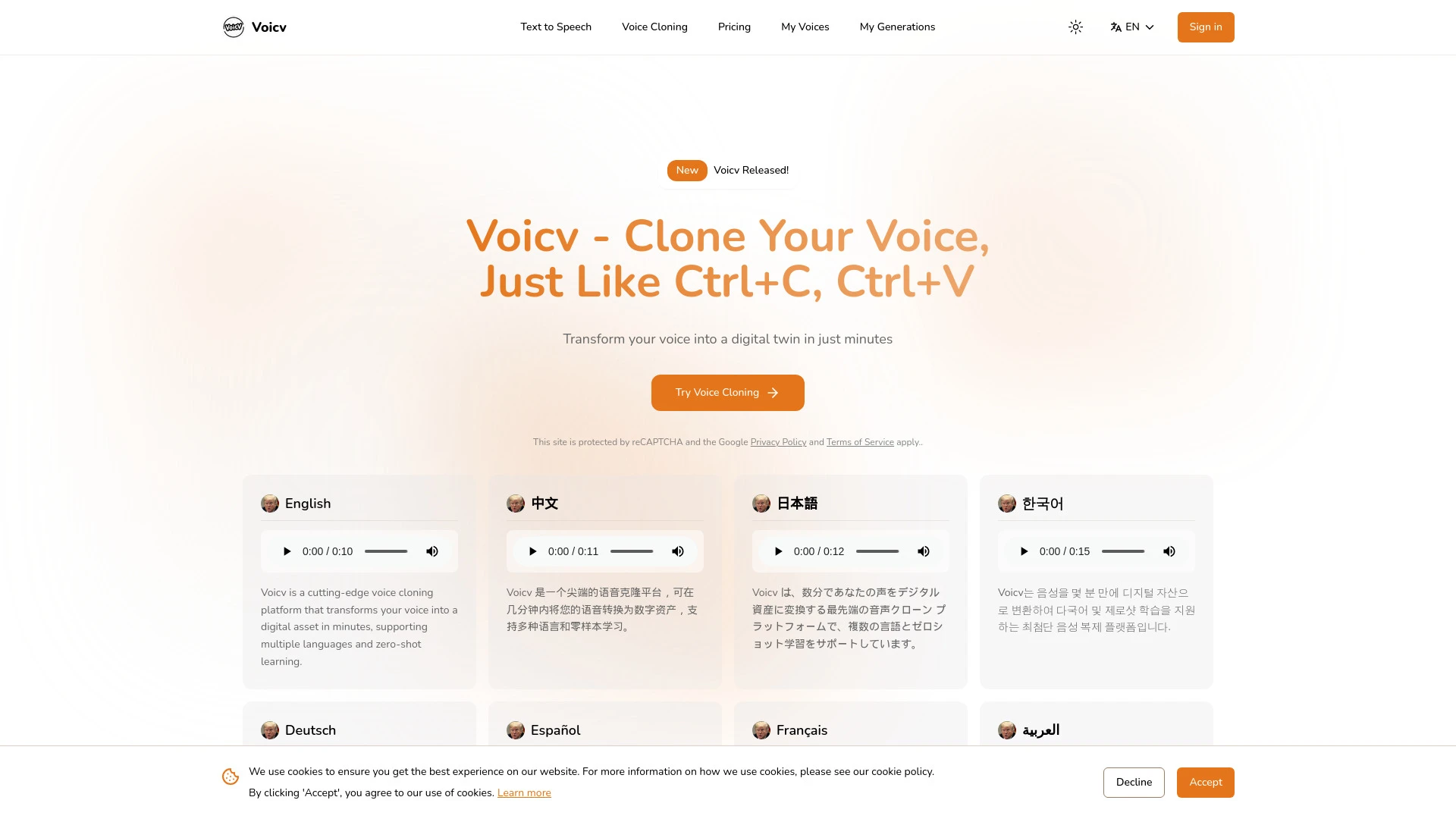
Voicv
Voicv is an innovative voice cloning platform that converts voices into digital assets with support for various languages.
- Zero-shot voice cloning
- Multilingual support
- Real-time processing
AI Analysis
Why use this AI Voicv for Clone Your Own Voice?
AudioGenius.ai
AudioGenius.ai is an AI voice cloning and translation tool tailored for diverse professional uses like dubbing and customer support.
- Real-time voice cloning
- Instantaneous voice translation
- Seamless speech translation
AI Analysis
Why use this AI AudioGenius.ai for Clone Your Own Voice?
Practical Workflows
Don't just buy tools—build a system. Here are 3 proven ways to integrate AI into your clone your own voice process.
Workflow 1: First successful Clone Your Own Voice task for complete beginners
- 1) Upload a clean, high-quality voice sample set (2–3 hours of clean audio with minimal background noise) to the Clone Your Own Voice AI tool.
- 2) Configure basic voice parameters (gender, pace, tone) and run the initial clone; review audios for natural prosody and pronunciation consistency.
- 3) Iterate with 1–2 short scripts, adjust emphasis and cadence, and export a baseline clone suitable for a simple narration task.
Workflow 2: Regular user optimizing daily Clone Your Own Voice work
- 1) Create a structured project with multiple voice profiles (e.g., onboarding, product updates) and tag samples by use-case.
- 2) Run automated quality checks (intonation, breath control, and noise floor) and apply consistency filters across sessions.
- 3) Schedule daily batch renders of short clips, compare with reference, and tune pronunciation vectors to maintain brand voice consistency.
Workflow 3: Power user achieving full Clone Your Own Voice automation
- 1) Build a reusable automation script that ingests new scripts, selects the appropriate voice profile, and triggers clone generation with predefined style guides.
- 2) Integrate evaluation metrics (MOS-like score, intelligibility, latency) and auto-adjust voice vectors for drift reduction.
- 3) Deploy end-to-end pipelines to update marketing, training, and accessibility assets with compliant clone outputs.
Effective Prompts for Clone Your Own Voice
Copy and customize these proven prompts to get better results from your AI tools.
Beginner
Create a 30-second narration in my clone voice describing a product feature. Output: plain text script and an audio file in WAV with natural pacing and clear pronunciation.Advanced
You are a brand voice supervisor. Role: Voice Artist. Context: Explain the product in a calm, persuasive tone with moderate tempo. Constraints: keep it under 60 seconds, include a CTA at the end. Format: JSON with fields text, audio_wav_base64, and metadata.Analysis
Compare two clone outputs for the same script: measure intelligibility, pacing consistency, and naturalness. Provide a 1-page report with scores, highlighted discrepancies, and recommended adjustments.
What is Clone Your Own Voice AI?
Clone Your Own Voice AI is specialized technology that creates a digital replica of a person’s vocal characteristics. It’s designed for professionals who need scalable, consistent voice output across media, training, and accessibility. It works best when there is explicit consent, clear licensing, and a defined usage policy that protects the original speaker’s rights.
Benefits of Using AI for Clone Your Own Voice
- Faster production of voice content without repeated studio sessions.
- Consistent branding across scripts, tones, and languages.
- Cost efficiency for large-scale voice tasks (updates, narrations, or translations).
- Enhanced accessibility with clear, natural-sounding speech.
- Safer, auditable usage with consented data and licensing controls.
How to Choose the Right Clone Your Own Voice AI Tool
- Voice fidelity and personalization controls: look for fine-grained timbre, pacing, and emotional range.
- Consent and licensing features: ensure clear rights management and data safety.
- Workflow integrations: compatibility with your CMS, DCO pipelines, and automation hooks.
- Quality assurance: built-in evaluation metrics and drift monitoring.
- Support and updates: active product roadmaps and user community.
Best Practices for Implementing Clone Your Own Voice AI
- Do obtain explicit, documented consent from the voice owner and clarify permitted use cases.
- Do start with clean, representative samples and validate outputs with target audiences.
- Do implement ongoing monitoring for drift and misuse, with rollback plans.
- Don’t rely on a single sample for long-term brand voice; refresh data periodically.
- Do maintain accessible transcripts and captions for every generated clip.
AI for Clone Your Own Voice: Key Statistics
AI-based voice cloning market grew 28% YoY in 2025, with 15% CAGR projected through 2026.
75% of enterprise teams report time-to-market improvements of 40% using Clone Your Own Voice AI pipelines.
64% of clone projects in 2025 used consented datasets; expected to rise to 82% by end of 2026.
Average improvement in perceived naturalness after model fine-tuning: +18 on MOS-like scale.
Top use cases: marketing narrations (32%), e-learning (24%), accessibility (18%).
Avg. project cost per minute of generated voice declined 22% in 2025 due to tooling efficiency.
Frequently Asked Questions
Get answers to the most common questions about using AI tools for clone your own voice .
Clone Your Own Voice AI refers to software that uses neural networks and advanced speech synthesis to replicate a person’s vocal characteristics, allowing you to generate new speech samples in that voice. It’s used for voiceovers, dubs, virtual assistants, and accessibility, provided you have consent and comply with laws.
Begin by collecting high-quality, consented voice data, select a suitable Clone Your Own Voice AI tool, configure target voice attributes (tone, pace, emotion), and generate test clips. Iterate using scripts that reflect your typical content to refine the clone before large-scale use.
A single robust Clone Your Own Voice AI tool can cover core cloning tasks efficiently, but a multi-tool approach offers specialization (different voices, higher fidelity, or better post-processing). Seek tools with strong safety, licensing, and update cadence for 2026 needs.
Common issues include insufficient or noisy input data, misaligned timing, aggressive prosody, or drift across sessions. Improve by providing cleaner samples, refining phoneme timing, using post-processing filters, and updating voice vectors with fresh data from consistent sources.
Related AI Tool Categories
Explore other AI tool categories similar to Clone Your Own Voice that might interest you.
AI Voice Chat Generator
AI Voice Chat Generators utilize advanced natural language processing and speech synthesis to create human-like conversa...
AI Voice Changer
AI Voice Changers utilize machine learning algorithms to alter or synthesize human voices. By analyzing pitch, tone, and...
AI Celebrity Voice Generator
The AI Celebrity Voice Generator uses deep learning to create realistic voice replicas of celebrities. By analyzing voic...
AI Voice Cloning
AI voice cloning uses deep learning to replicate human voices, enabling the creation of realistic speech from text. Appl...
AI Lip Sync Generator
The AI Lip Sync Generator uses artificial intelligence to synchronize facial movements and lip motions with audio, enhan...