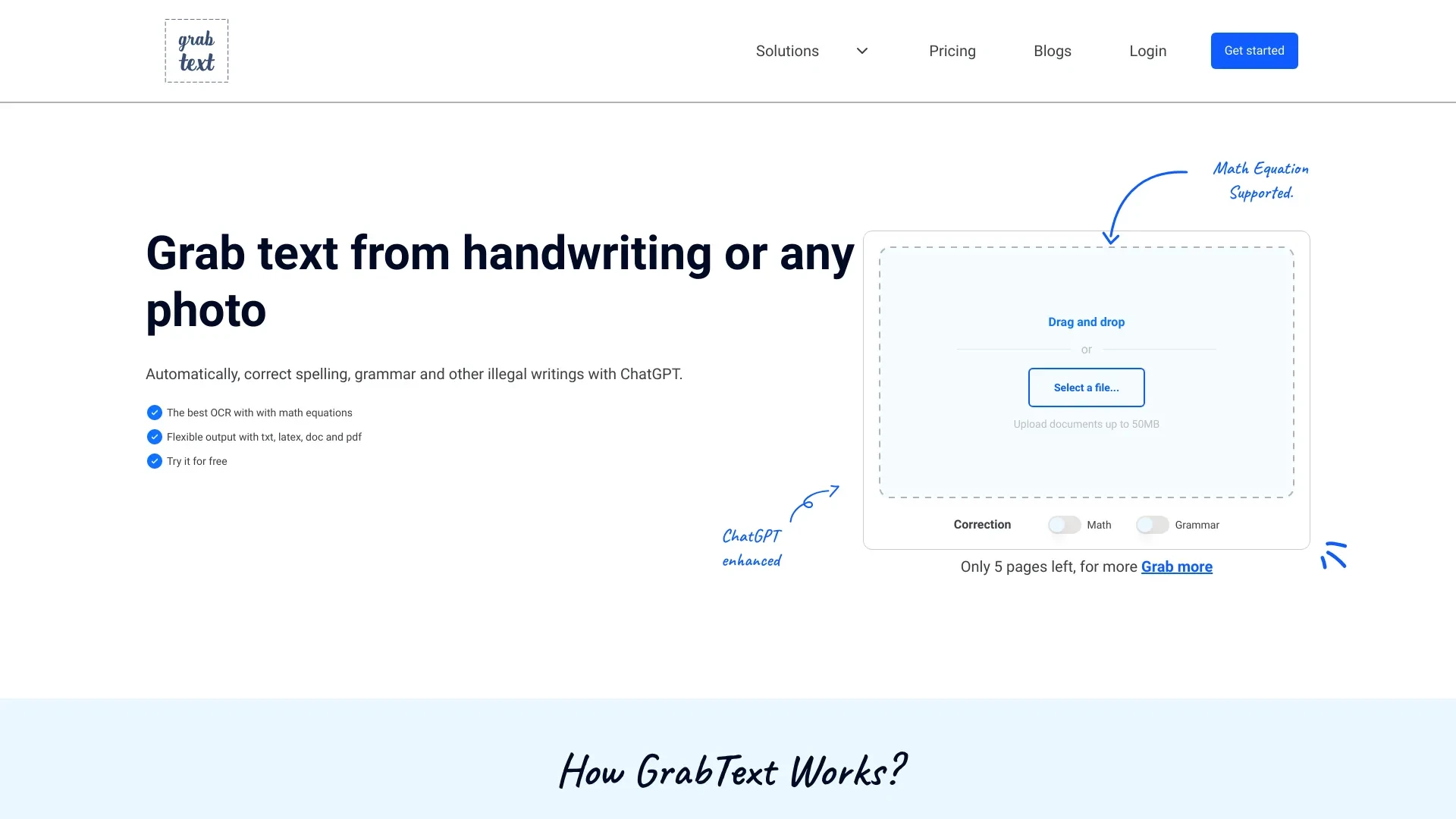
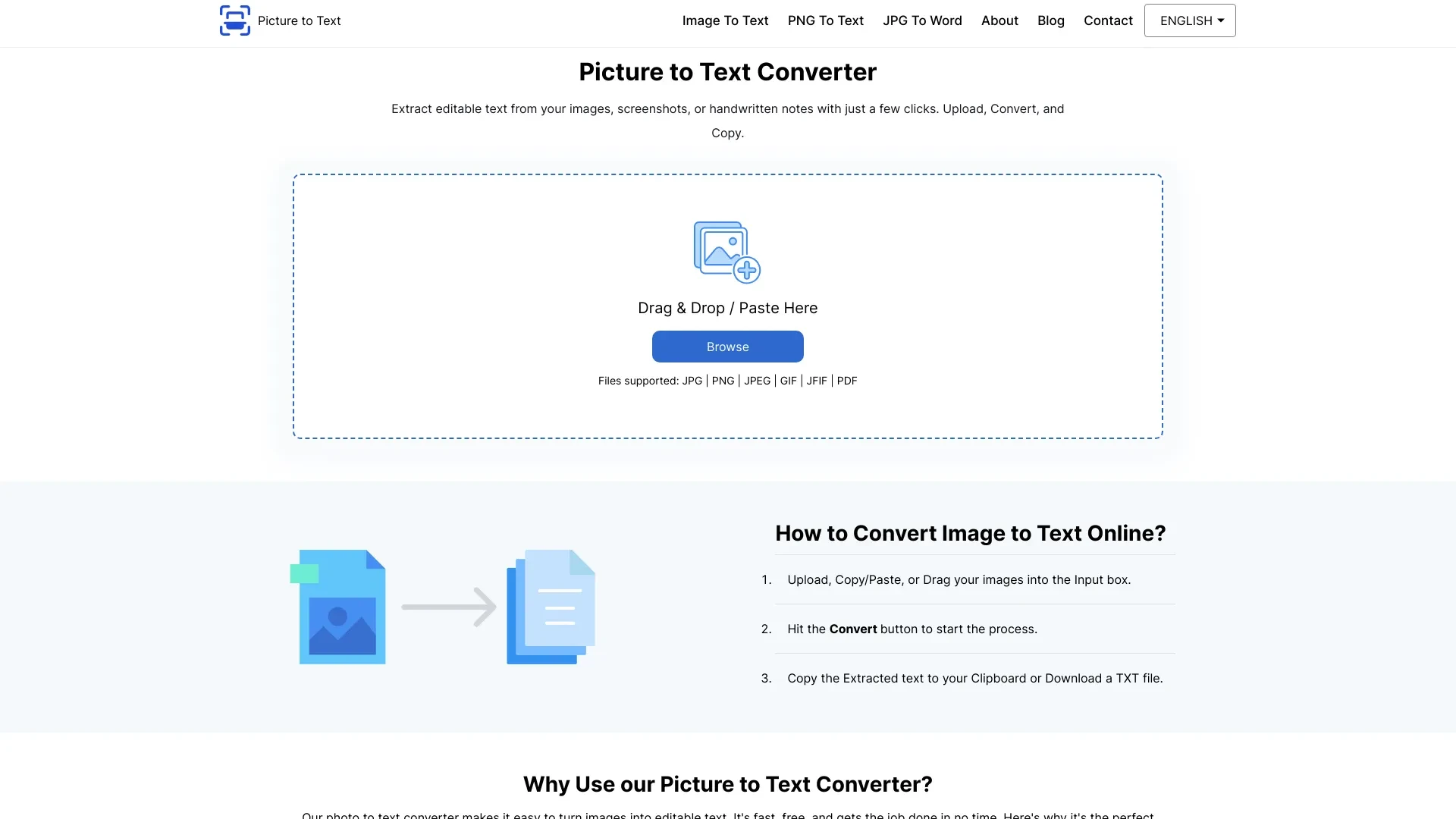
GrabText and Picture to Text Converter are web based OCR tools that turn handwritten or photographed text into editable content. GrabText emphasizes LaTeX conversion and export versatility, while Picture to Text Converter highlights fast bulk processing and a free access model. Both target students and professionals who digitize paper content.
Convert handwritten notes into digital format
Capture printed text from images
Automate document archiving and cataloging
Facilitate transcription for academic research
Simplifies text digitization
Saves time on manual typing
Supports multiple file export formats
Optical character recognition for handwritten and printed text
Conversion of LaTeX equations
Automatic error correction
Export options to multiple file formats
User-friendly interface
Digitize Office Documents
Screenshot to Editable Text Conversion
Efficient Invoice and Receipt Digitization
Translate Signboard Text Online
User-friendly interface
Supports multiple languages
Flexible batch processing
Easy to Use
Advanced AI-Based Extraction
Multi Image Format Support
Batch Processing
Data Security and Privacy
| Factor | GrabText | Picture to Text Converter |
|---|---|---|
| Ease of Use |
|
|
| Features |
|
|
| Value for Money |
|
|
| Interface Design |
|
|
| Learning Curve |
|
|
| Customization Options |
|
|
For academic and research workflows with heavy equations, GrabText is the stronger choice thanks to its LaTeX conversion and versatile exports. For fast, cost free digitization of everyday documents and multilingual batch processing, Picture to Text Converter delivers immediate value. In practice, test both on representative documents, verify LaTeX outputs, and assess data privacy requirements before committing to a long term plan.
Jamie Davis
Software Analyst
If your priority is scholarly work with precise LaTeX equation handling and rich export capabilities, GrabText is the recommended option. If you need rapid, free OCR with batch processing across multiple formats and languages, Picture to Text Converter is the smarter fit. Your final choice should align with whether LaTeX fidelity and subscriptions or free immediate access and speed best serve your workflow.
GrabText offers a freemium option with 0.00 price and a monthly subscription for premium features. Picture to Text Converter is presented as a free service with one time billing in a consumption style. The contrast highlights a subscription driven approach for GrabText versus immediate free access for Picture to Text Converter with usage based consideration.
No numeric speed benchmarks are provided. GrabText indicates fast text capture as part of its core features, while Picture to Text Converter markets fast processing speed and batch processing. Both rely on established OCR architectures to deliver reliable results across typical use cases.
Both tools are web based with user friendly interfaces. GrabText emphasizes a fast capture workflow and a straightforward export path for multiple formats, while Picture to Text Converter stresses ease of use and batch processing for handling multiple images efficiently. Onboarding is likely quick given image or photo input focused workflows.
Both tools operate on a Web platform with export options and multi format support. There are no explicit external integrations or platform ecosystems described beyond these capabilities.
OCR output can vary based on image clarity and handwriting quality, which may affect accuracy. GrabText focuses on LaTeX equation conversion which is highly beneficial for some academic tasks but may introduce additional formatting considerations. Picture to Text Converter being free suggests broad accessibility, though long term usage dynamics and potential limits are not specified.